

The Roads to Carbon Neutral - Season 5 - Episode 7 - Double Harvesting With Agrivoltaics
The Roads to Carbon Neutral - Season 5 - Episode 7
Double Harvesting With Agrivoltaics














The Roads to Carbon Neutral
The fifth season of our program entitled “The Roads to Carbon Neutral”, in partnership with CNBC Catalyst, provides an insight into the solutions and innovations making the transition to low-carbon energy a reality and helping us with our net zero approach, together with society. These powerful on-the-ground stories are led by TotalEnergies’ employees.
For this seventh episode, we are heading to Aix-en-Provence, where TotalEnergies has set up its agrivoltaic center of excellence. Etienne Drahi, Head Solar R&D at TotalEnergies, takes us to an experimental agrivoltaic site run by Ombrea, before stopping at the Platform for Experimental Research in Lacq (PERL), where our engineers and scientific experts are working on the agrivoltaics of tomorrow and striving to develop ever more innovative solutions to combine increased energy production with improved agricultural performance.
Étienne Drahi, Head of Solar R&D, TotalEnergies: This region has inspired artists such as Van Gogh, Monet and Cézanne. It's also famous for its agricultural activity. But Europe, like other places in the world, is facing climate change and raising temperatures, which is putting a lot of pressure on farming. Agrivoltaics is one way to help agriculture adapt while also supporting the energy transition in landscapes like Provence.
[The Road to Carbon Neutral: Harvesting twice]
[Farm Domaine de la Cabanasse, Provence, France]
Étienne Drahi: There are growing concerns about the availability of agricultural land. We need to find ways to optimize the use of the land.
[Experimental site, Saint Martin de Crau]
Étienne Drahi: Agrivoltaics involves putting solar modules on top of lands used for farming or livestocks, making it possible to generate energy while also supporting food production.
Marion Alaux, Agronomist, Ombrea: Ombrea is pioneering agrivoltaic solutions. The AgriPV contributes to combining food and energy sovereignty on the same plot. In addition, there are more and more climate changes and extreme conditions. So the panels will protect this crop which is very sensitive to hail, rainy episodes, drought.
[Panels move according to natural phenomena]
Etienne Drahi: Extreme weather events cost the agricultural sector in Europe, billions and billions of euros every year. With agrivoltaics this risk can be mitigated.
Marion Alaux: We have installed sensors in the AgriPV park, which allow us to see in real time the moisture of the soil in the air as well as the effect of wind and light.
[Ombrea Data Lab, Provence]
Marion Alaux : It’s in Ombreas’ premises that we view in real time all the sensors that are here on site and that allow us to adapt the control of the panels.
Patrice Vulpian, Local Farmer, Provence: For the past five or six years, we have started to have episodes of heat waves. And also episodes of violent thunderstorms with hail. So we are obliged to protect ourselves, to try counter these climatic hazards, which have become more and more numerous.
Etienne Drahi: We are not only putting modules on top of crops. They are being design tested and operated to work alongside and even support the growth of crops. TotalEnergies aim to produce 100 terawatt hours of electricity by 2030. And a significant portion of that will come from solar energy.
[PERL Research Centre, Lacq, France]
Pierre Sauquet, Researcher at PERL, TotalEnergies : We are continuously striving to innovate between energy production and maintaining the agricultural productivity. This is one of the focuses at PERL research center. Soil is precious. It can take up to 1,000 years to form one centimeter of soil. We can characterize the soil and the plants from the microscopic scale, looking at the microbes, studying microbe diversity, microbial activity to the very large-scale using satellite data and we can monitor vegetation. For large scale experiments, we developed the InnoAgri experimental platform, where we test different technologies, where we can try different panel densities or different panel tracking algorithms and study impact on crop growth.
Etienne Drahi : I believe this is just the beginning. It might be at small scale but what we do here in France could have a real impact and serve as a blueprint, expanding agrivoltaics across Europe and beyond.
[TotalEnergies logo]
Combining food and energy sovereignty on the same plot of land
Agrivoltaics (or agriPV) involves installing solar panels on the same arable land to produce food while generating electricity. This dual use not only avoids land use conflicts, but also enhances food security and supports the development of renewable energies.
This model is especially appealing to the Company in light of its major ambition of generating over 100 TWh of electricity every year by 2030, with 70% from renewable sources, even though the land available for setting up solar power plants is limited.
In addition, as in other regions of the world, agriculture in Europe is under threat from climate change and rising temperatures. Every year, extreme weather events cost the European agricultural sector billions of euros. As such, agrivoltaics would appear to be an appropriate solution, since agrivoltaic systems can shield crops against climate-related hazards, reduce heat or water stress, and bring clear agronomic benefits to the plots concerned.
Deep inside an agrivoltaic site managed by Ombrea
Faced with new environmental, economic and social challenges, agrivoltaics is shaping up as a solution to help protect crops against climate-related hazards and support farmers with the energy transition by reducing their carbon footprint and generating new revenue streams. This particular area is fertile ground for research, since it calls for multidisciplinary teams offering expertise in modeling, biology, agriculture, solar energy and experimentation. In September 2023, the Company announced that it had acquired Ombrea to support the energy and agricultural transition.
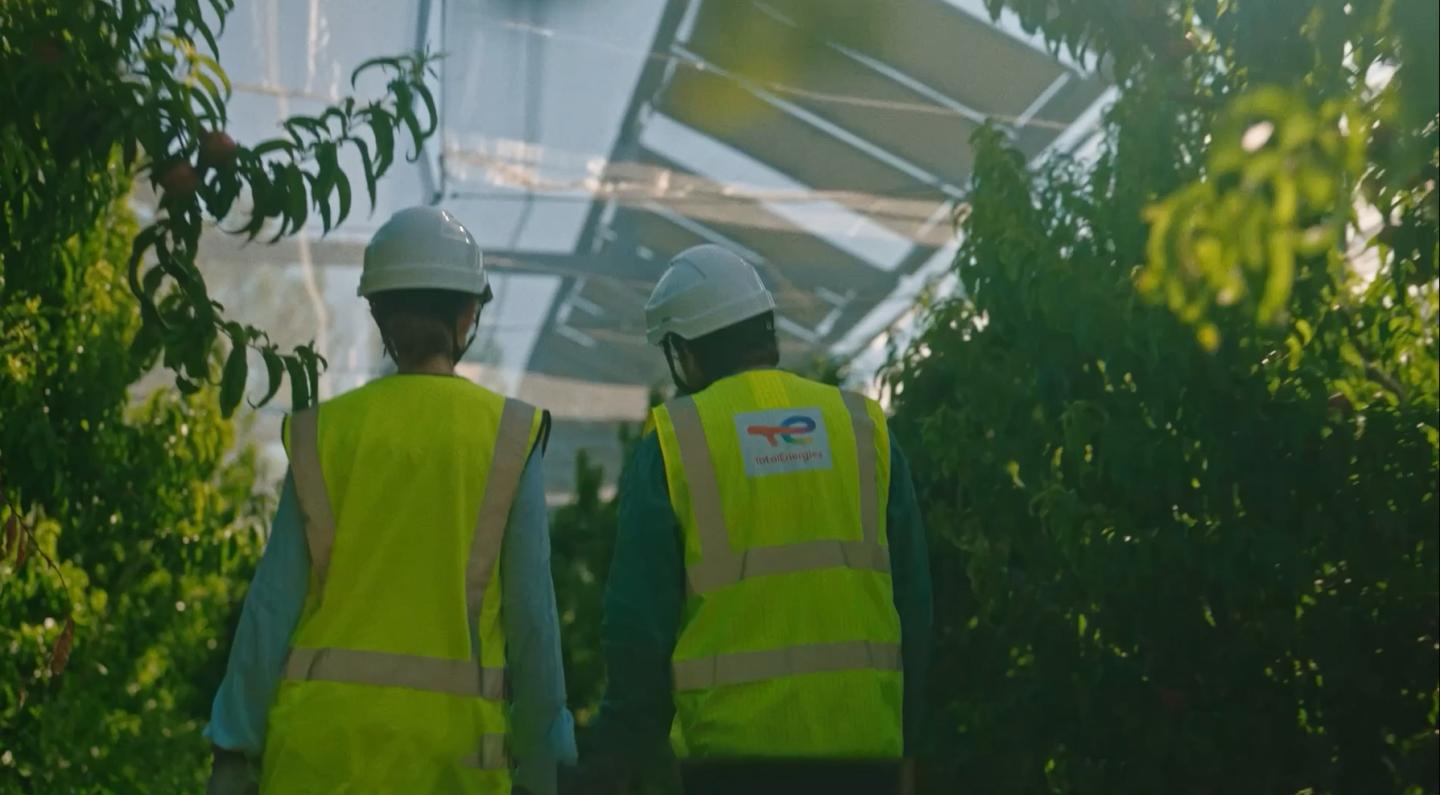
Marion Alaux, an agronimist at Ombrea, takes us on a tour of one of its agrivoltaic demonstrators at the “Domaine de la Cabanasse” fruit farm in Saint-Martin-de-Crau. The solar panels installed across the site have been designed, tested and operated to avoid encroaching on the crops and thereby encourage their growth.
They provide physical protection for crops that are susceptible to hail, heavy rainfall and droughts. In addition, sensors embedded in the agriPV facility provide real-time data on soil moisture, air quality, wind and light conditions, meaning that the panels can be adjusted to improve crop growing conditions while maximizing energy production.
Check out our other pilot sites and results for agrivoltaics
Ombrea in figures
It might still be at small scale, but what we do here in France could have a real impact and serve as a blueprint expanding agrivoltaics across Europe.Etienne Drahi Head of Solar R&D, TotalEnergies

Harnessing innovation to address the challenges of agrivoltaics
At TotalEnergies, we are constantly breaking new ground to increase energy production while improving agricultural performance. This is one of the priority areas at our Platform for Experimental Research in Lacq (PERL), where several teams of researchers are working on the agrivoltaics of tomorrow. They study the impact of solar panels on soils and crops, while collecting hundreds of datasets to power the center’s plant growth models and solar panel control algorithms.
In Lacq, we have also developed an experimental platform, called InnoAgri, where we can test different technologies on a large scale, and try out various panel densities or different panel algorithms to examine their impact on crop growth.
The Roads to Carbon Neutral