
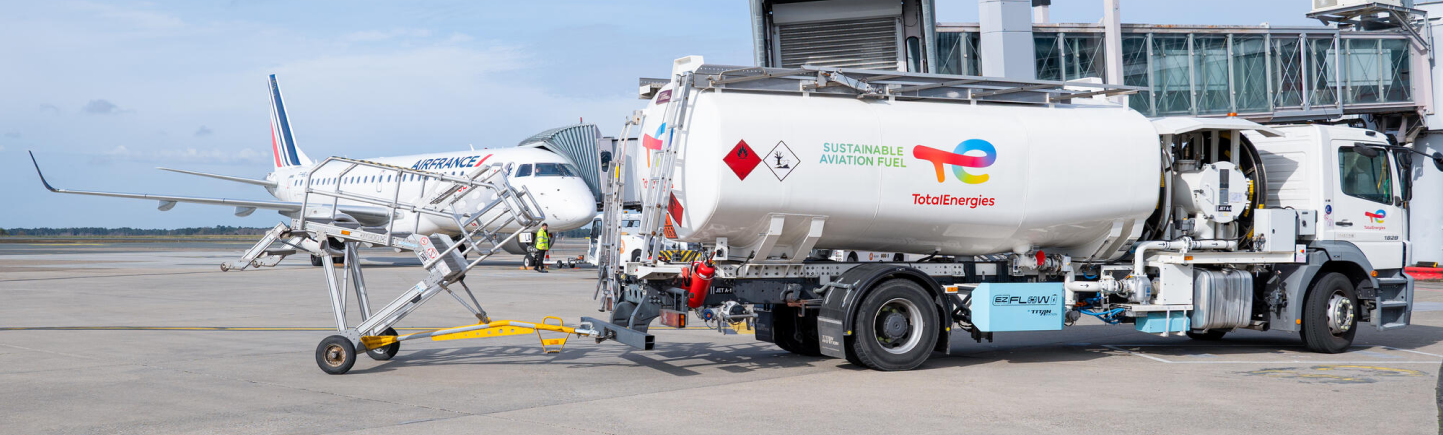
SAF: the Fuel that Helps Decarbonize Aviation

Feature

Sustainable aviation fuel (SAF) is a major step forward for the aviation industry. This fuel can be produced from several types of renewable raw materials, such as biomass or waste and residues from the circular economy. It is one of the keys to reducing greenhouse gas emissions from air transport, which currently accounts for more than 2% of global emissions(1). TotalEnergies is developing SAF to support its customers in the aviation sector in their own decarbonization goals. We are investing in the transformation of our refineries and the development of SAF production units, and are developing partnerships with key industry players such as Airbus, Safran, and the Air France-KLM group. Here is an overview of the challenges, technological advances, and initiatives undertaken by TotalEnergies to understand how sustainable aviation fuel is helping to transform the future of aviation.

What is SAF?

Sustainable aviation fuel (SAF) is the term used by the aviation industry to describe alternative fuel made from sustainable raw materials. At TotalEnergies, we produce SAF from waste and residues from the circular economy, such as used cooking oil and animal fats. It is also possible to use solid waste such as agricultural waste, wood residues, municipal waste, and sewage sludge. Depending on the raw material used and the production process, SAF can be blended with kerosene in proportions ranging from 10% to 50% to obtain an alternative fuel containing SAF.

Depending on the raw materials and production process used, SAF can reduce CO2 emissions by up to 90% over its entire life cycle, compared to traditional fossil fuel (“JET A-1”). There are many different SAF production processes, all of which must comply with complex specifications in order to meet the requirements of regulators and manufacturers in terms of both safety and operational performance.

Its properties are very similar to those of JET A-1, making SAF ready for use (known as a “drop-in” fuel) and allowing it to be used in existing fleets without requiring any adaptation of aircraft or supply and storage infrastructure.

SAF contribute both to the energy transition of our customers in the aviation sector and to the industrial transition of our refineries. They therefore represent a truly promising “win-win” sector for industry and aviation.
Patrick Pouyanné CEO at TotalEnergies

At TotalEnergies, we produce SAF from European waste and residues, such as used cooking oil and animal fats, using two main processes.

First method of SAF production: hydrotreatment in biorefineries

Among the various patented technologies for producing SAF, the HEFA (hydroprocessing of vegetable oils and oil residues) process is currently one of the most mature. This process produces SAF, which is then blended with JET A-1 to obtain an aviation fuel containing SAF that can be directly supplied to aircraft.

Second method of SAF production: co-processing

Co-processing involves incorporating raw materials from the circular economy into traditional refinery units, in addition to fossil-based feedstock, to directly produce aviation fuel containing SAF that is already blended. This is a fast and more economical way to produce SAF using existing infrastructure.

A third alternative under development: e-SAF

The SAF family also includes e-fuels, synthetic fuels produced from hydrogen, ideally derived from renewable electricity and CO2, which can be extracted from ambient air or industrial effluents. These technologies, currently at the R&D stage, remain extremely costly but could become a particularly promising avenue in the longer term.

Since 2014, just one year after the first flights using SAF, we have been innovating with our partners, aircraft manufacturers, and industrial partners to develop this technology.

Here are some of the major milestones in this development:

  • 2016: The Company begins supplying SAF to certain aircraft delivered to airlines from the Airbus site in Toulouse.
  • April 2021: First production of SAF at our La Mède biorefinery and our Oudalle site in France.
  • May 2021: First long-haul flight from Paris-Charles-de-Gaulle powered by fuel containing SAF produced by TotalEnergies.
  • September 2021: Signing of a strategic partnership with Safran to accelerate the decarbonization of the aviation sector.
  • October 2021: First flight in collaboration with Airbus, Safran, Dassault, ONERA, and DGAC, powered by 100% TotalEnergies SAF.
  • September 2021: TotalEnergies and Safran form a strategic partnership to accelerate the decarbonization of the aviation sector.
  • March 2022: First production of SAF from co-processing at the Normandy platform in France.
  • December 2023: On the sidelines of COP28, first flight demonstrating the feasibility of producing SAF from methanol, in partnership with Masdar.
  • March 2023: First flight of an A319neo powered by 100% SAF.
  • February 2024: Signing of a strategic partnership with Airbus for the development of SAF.
  • September 2024: signing of an agreement to supply SAF to Air France-KLM Group airlines, representing up to 1.5 million tons over a 10-year period

By 2028, the Company will be able to produce more than half a million tons per year of sustainable aviation fuels to meet the increase in the European mandate for incorporation set at 6% by 2030.

TotalEnergies currently produces SAF by capitalizing on its existing assets:

  • Grandpuits biorefinery. Thanks to a €500 million investment, TotalEnergies is transforming its site into a zero-oil platform, including a biorefinery with a production capacity of 230,000 tons/year of SAF, which will start production in 2026. TotalEnergies is partnering with SARIA, the European leader in the collection and recovery of organic materials, which will supply most of the raw materials.
  • La Mède biorefinery. The site will produce 15,000 tons/year of SAF this year to supply airports in the southern region.
  • Normandie refinery. TotalEnergies has started SAF production there using co-processing, a production process that allows fossil-based aviation fuels and biomass to be processed simultaneously in a conventional refining unit. The site has a production capacity of 160,000 tons/year.
  • Antwerp refinery. An initial project to produce 50,000 tons/year of SAF through co-processing is being implemented this year. Production capacity will subsequently be increased to 80,000 tons/year.
  • Leuna refinery. A project to produce 50,000 tons/year through co-processing is planned for 2026.
  • Satorp. The site has successfully processed used cooking oil to produce SAF through co-processing.
  • Saudi Arabia. TotalEnergies, Aramco, and SIRC will evaluate the possibility of building a SAF plant.
  • China. TotalEnergies strengthens its partnership with Sinopec and aims to develop SAF production of around 230 kt/year.

Current regulations allow for a maximum SAF blend of 50% in JET A-1, depending on the technology used. But the entire sector—regulators, manufacturers, and SAF producers—is working together to enable civil aviation to exceed this threshold as quickly as possible. For example, we have entered into an R&D partnership with equipment manufacturer Safran to test engines using 100% SAF. Manufacturers Airbus and Boeing are also working to ensure that their aircraft can fly on 100% SAF by 2030.

In 2022, aircraft manufacturer ATR announced that it had completed the world's first flight using 100% SAF in both of the aircraft's engines. A year later, in November 2023, Emirates became the first airline to fly an Airbus A380 with an engine running on 100% SAF. A few days later, Virgin Atlantic made the first 100% SAF transatlantic flight in history on a Boeing 787. Finally, in March 2023, TotalEnergies refueled the first flight of an A319 Neo on 100% SAF. These flights demonstrate the ability of infrastructure and aircraft to operate with incorporation rates well above what is currently permitted. The large-scale development of SAF will depend on the availability of sustainable raw materials, which remains a major challenge for the entire sector today.

At TotalEnergies, we intend to meet the challenges of investment and production necessary to scale up a technology that currently accounts for less than 0.1% of global aviation fuel volumes.