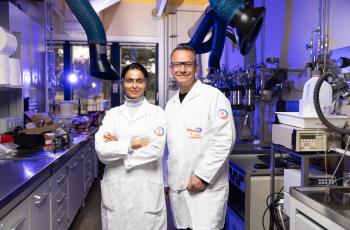


Location: France
Partners: TotalEnergies (100%)
Activities: supercomputer
Commissioning: 2013 (Pangea 1) / 2027 (Pangea 5)
in computing power
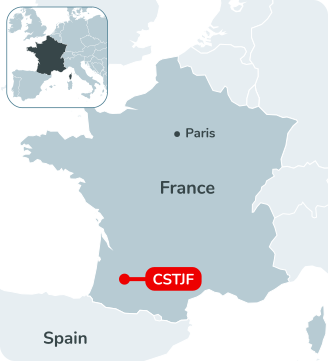
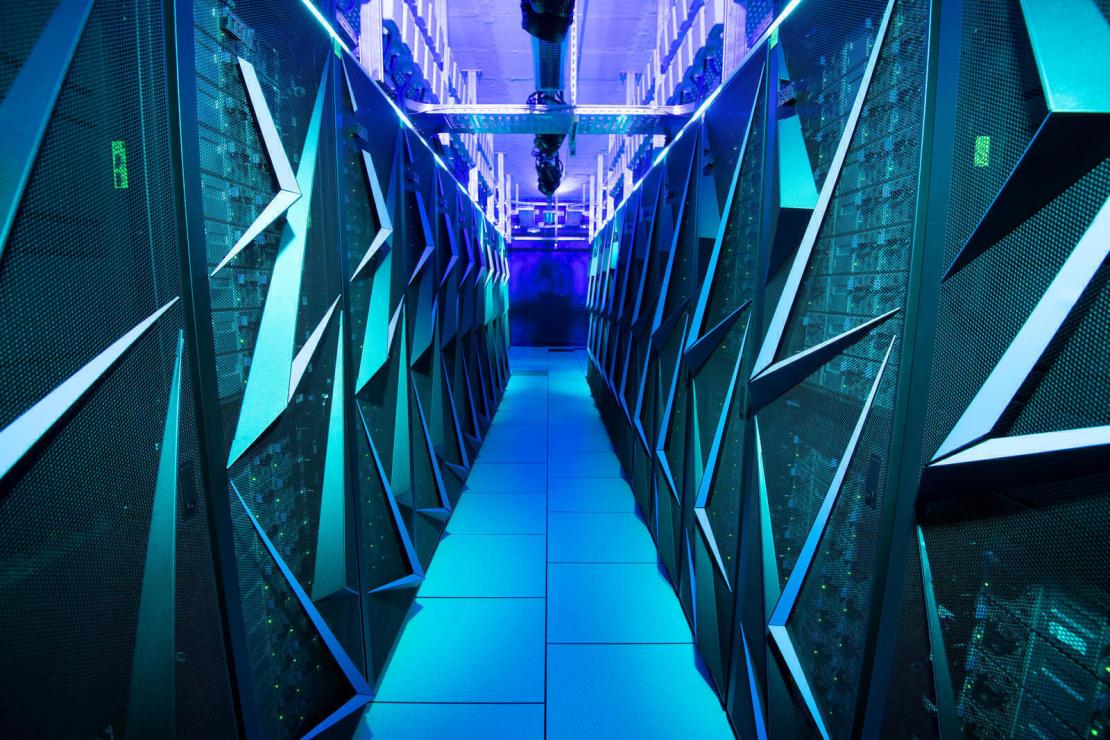
In 2013, TotalEnergies commissioned Pangea, its first industrial supercomputer (or HPC, for high-performance computing), hosted at the Company’s Scientific and Technical Center in Pau, France (CSTJF). Since then, several generations of this supercomputer have followed, continuously pushing further in modeling and simulation, which are essential for the development of the Company’s activities. Announced in 2026, Pangea 5 will increase the Company’s computing power sixfold and represents an investment of over 100 million euros.
2013-2019: a look back at three generations of supercomputers
In 2013, TotalEnergies equips with Pangea, the Company’s first industrial supercomputer. Its arrival marks the entry of our systems into the petaflops domain (floating-point operations per second, a unit for measuring the computing speed of an IT system). Pangea I can perform 10^15 operations per second, demonstrating a remarkable level of performance thanks to its advanced processors and efficient data management.
Within the space of six years, the supercomputer's power underwent a fivefold increase. Pangea II, which was commissioned in 2016, climbed to 11th place in the semi-annual TOP500 ranking of the world's most powerful supercomputers. In 2019, Pangea III had a theoretical power of 31.7 petaflops, the equivalent of 170,000 laptops.
2023: arrival of the hybrid solution Pangea 4
Although Pangea III is still in service, Pangea 4 joined the ranks of TotalEnergies' supercomputers in early 2024. Combining computing power with energy efficiency, Pangea 4 is a hybrid solution consisting of a physical machine on site and access to computing capacity in the cloud – the Pangea@Cloud machine. The cloud allows us to benefit from regular updates and stay at the cutting edge of supercomputing technology. Smaller and more energy-efficient than its predecessor Pangea II, Pangea 4 uses 87% less electricity, and its access to the cloud also means a reduction in the carbon footprint of our datacentres.
Scientific computing to address TotalEnergies' energy transition challenge
Initially developed to support the Company's exploration and production activities, Pangea is now open to all its activities. Pangea 4 has been designed to meet the requirements identified for the period 2024-2028:
- simulations of reservoir storage capacity and assessment of well integrity as part of our carbon capture and geological storage (CCS) projects;
- calculations of methane emissions reduction;
- wind flow simulations for the design and siting of wind farms;
- simulations on biofuels and polymers;
- image processing, seismic acquisition, reservoir simulation and geological basin modelling as part of our exploration and production activities.
2026: computing power increased sixfold with Pangea 5
TotalEnergies, in collaboration with Dell Technologies and NVIDIA, announced in May 2026 the signing of a contract for the design and installation of Pangea 5, its next high-performance supercomputer. Hosted at the Jean Féger Scientific and Technical Center (CSTJF) in Pau, in the South of France, Pangea 5 will multiply the Company’s computing power by six.
With this increase in processing speed, Pangea 5 will:
- expand the deployment of advanced seismic engineering to enhance the accuracy of subsurface imaging and accelerate exploration to support the Company’s strategy for low-cost and low-emission hydrocarbon production;
- support R&D uses of AI and meet growing digital needs to optimize computing times and deepen the understanding of complex phenomena like Integrated Power models.
Controlled energy consumption and CO2 emissions
Pangea 5 will rely on specialized processors, capable of massively parallel computations, offering greater energy efficiency than previous versions. At equal performance, Pangea 5’s energy consumption will be reduced by approximately 40%, and its associated cooling system’s consumption will be cut by a factor of five. The residual heat generated by the supercomputer will be recovered and used to help heat the buildings of the CSTJF, which host more than 2.500 people.