


Location: Worldwide
Partners: TotalEnergies, CNRS, University of Reims Champagne-Ardenne
Main activity: Detection and measurement of methane and carbon dioxide emissions
Commissioning: 2022
-80%
Our target for reducing methane emissions on operated activities in 2030 compared with 2020

Methane emissions have many dispersed sources (animal husbandry, fossil fuel production and combustion, transportation, decomposing waste, etc.). As a pioneer in detecting and quantifying emissions in real-life conditions, TotalEnergies is using the AUSEA technology developed in cooperation with the French National Centre for Scientific Research (CNRS) and the University of Reims Champagne-Ardenne. It is one of the means we are using to reach our objective of near-zero methane emissions from our operations by 2030.
Methane is a greenhouse gas with a global warming potential 30 times higher than that of CO2 and a much shorter atmospheric lifetime(1). Reducing methane emissions is a priority, and TotalEnergies intends to establish an exemplary track record in this area.
Pioneers in methane emissions detection and measurement with AUSEA
Deployed in 2017, in partnership with the CNRS and the University of Reims Champagne-Ardenne, AUSEA is a technology mounted on a drone, the ultra-lightweight dual sensor simultaneously detects methane and CO2 with high accuracy and is now considered an international benchmark technology and one of the best drone technologies for methane detection(2).
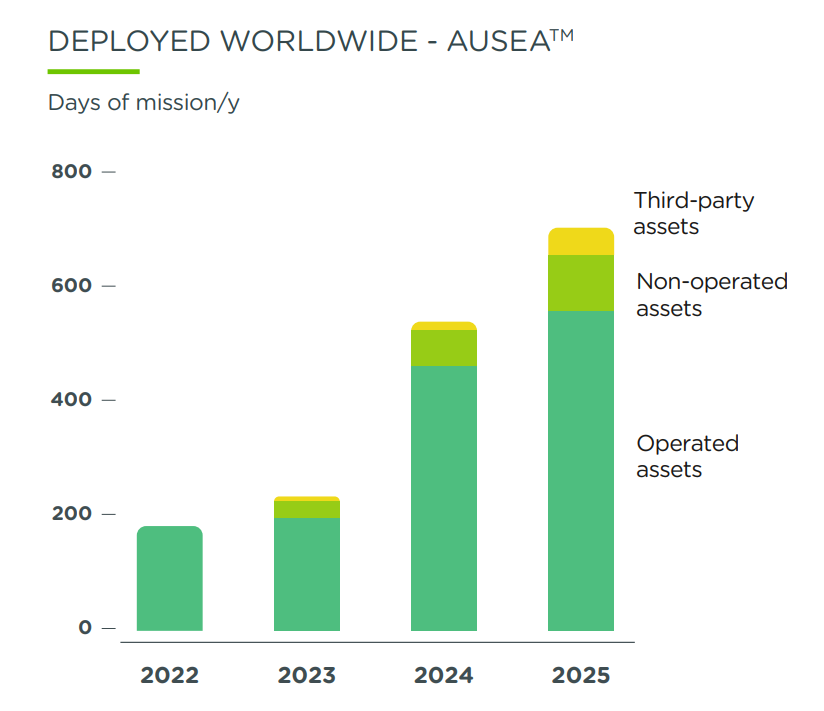
In 2022, TotalEnergies deployed AUSEA drone technology at its upstream sites, complementing the annual leak detection and repair (LDAR) campaigns. All of the Company's upstream sites are currently subject to an AUSEA detection campaign at least once a year.
TotalEnergies has also successfully deployed its AUSEA drones with partners under cooperation agreements with national oil and gas companies and other industry players (Petrobras, Sonangol, NNPC, Socar, ONGC, Oil India Limited, and Gladstone LNG) to conduct methane detection and measurement campaigns using AUSEA technology, thereby demonstrating a shared commitment to identifying, quantifying, and reducing methane emissions and encouraging the entire oil and gas industry to aim for near-zero methane emissions by 2030.
Worldwide deployment of AUSEA
Reducing methane emissions: a priority for the Company
The first challenge of the Company is to continue to provide the energy the world needs while significantly reducing the emissions generated by our operations. One of our priorities remains methane reduction, with the ambition of achieving near-zero methane emissions by 2030.
TotalEnergies has long been committed to reducing its methane emissions by taking specific actions on each of the four sources: flaring, vents, stationary combustion and continuous real-time detection to identify any fugitive emissions.
Between 2010 and 2020, TotalEnergies reduced methane emissions from its operated assets by nearly half. In 2025, it exceeded its target of reducing methane emissions by 60% compared to 2020, achieving a reduction of 65%. TotalEnergies has set a new target of -70% in 2026 and is on track to achieve its goal of an 80% reduction by 2030(3) or sooner.
(1) Around a dozen years, compared to several hundred years for CO2. Global warming potential of around 30 over 100 years (source: IPCC AR6). ↑
(2) Stanford & IMEO study: Controlled release testing of multiple European methane measurement technologies. ↑
(3) Compared to 2020. ↑


