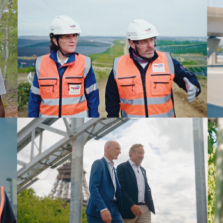


Energy Horizon - Season 1 - Episode 3 - The Balance of Power

Energy Horizon - Season 1 - Episode 3
The Balance of Power
Energy Horizon
Our partnership with CNBC is reinventing itself to bring to life our new series, “Energy Horizon,” an inspiring and optimistic vision of TotalEnergies' role in the energy challenges of today and tomorrow. Through powerful, human stories rooted in the field, each episode takes you to the four corners of the globe to discover the solutions and innovations embodied by the men and women of the Company working to drive the energy transition.
In this third episode, Christopher Elias, Head of Renewables Origination at TotalEnergies, guides us around Texas to show TotalEnergies’ Integrated Power Strategy across the entire electricity value chain—from origination and renewable generation to gas-fired firming capacity, trading, and customer supply.
Texas: an illustration of TotalEnergies's Integrated Power strategy
One of the pillars of TotalEnergies’ strategy is to expand across the entire electricity value chain. Expansion in renewable electricity is at the heart of TotalEnergies’ Integrated Power strategy. The Company plans to increase its net electricity production to 100-120 TWh by 2030, with approximately 70% of that electricity coming from renewable sources and 30% from flexible generation assets.
To support this ambition, TotalEnergies is developing a competitive and diversified portfolio of renewable assets, mainly wind and solar, while continuing to invest in flexible generation solutions such as CCGTs and battery storage. By combining complementary sources of renewable production and flexibility, the Company is strengthening the foundations of a more integrated, resilient and reliable power system. This approach contributes to securing electricity supply while enabling TotalEnergies to provide its customers with increasingly lower-carbon electricity, available whenever it is needed.
The United States is currently experiencing one of the fastest increases in electricity demand in its history, driven by demographic growth, accelerating electrification, and the rapid development of AI data centers. Responding to this structural growth requires a fully integrated energy system, in which power generation, storage, thermal backup and real-time trading operate in close coordination to deliver firm and reliable electricity.
In this context, Texas represents a strategic market for TotalEnergies. As the leading U.S. state for renewable electricity generation and the country’s fastest-growing battery storage market, Texas offers a particularly relevant environment to demonstrate the value of an integrated power model designed to combine competitiveness, flexibility and reliability.
The complementarity of renewables and flexible assets
One of the first steps in building such a system is bringing different energy sources together, starting with harvesting natural resources such as wind and solar, and integrating them into a broader energy ecosystem capable of meeting rising electricity needs.
Piedra Solar
A key example is the TotalEnergies Piedra Solar farm in Freestone County, which, once completed, will span nearly 3,000 acres and provide a significant source of renewable power for the Texas grid.
To further strengthen the site's contribution to grid reliability, TotalEnergies also plans to develop large-scale battery storage facilities. These batteries will store excess solar generation and release it when demand peaks or when sunlight is unavailable, helping to ensure a more stable, flexible, and reliable energy supply.
By combining renewable generation with energy storage, the site illustrates TotalEnergies’ integrated approach to the electricity value chain. In addition, it offers a range of solutions, from certified renewable energy credits to tailored energy packages that pair land access with on-site power generation. As a result, it directly supports the decarbonization ambitions of both established industrial players, such as LyondellBasell and Saint-Gobain, and leading digital companies, including Google and Amazon.
Piedra Solar in key figures
Colorado Bend I: the engine room
Solar farms such as Piedra Solar generate large amounts of renewable electricity, but when renewable output falls short or demand suddenly increases, the grid requires additional support. This is where Combined Cycle Gas Turbines (CCGTs), such as Colorado Bend I, located in Wharton County, play a critical role. Able to ramp up quickly, they provide reliable power whenever solar or wind generation declines.
A CCGT produces electricity by using natural gas to drive a first turbine, then capturing the waste heat to generate steam that powers a second turbine, significantly increasing efficiency. Because these plants can be started and adjusted as needed—using, in part, natural gas produced and traded by TotalEnergies—they complement renewable generation and help ensure a secure electricity supply.
The Colorado Bend I plant is also strategically located within the Houston power grid, a region experiencing strong growth in electricity demand driven by expanding industrial activity, data centers, and electrification trends. Today, TotalEnergies owns and operates three gas-fired power plants in Texas, representing a combined generation capacity of 1.5 GW.
However, generating power is only part of the equation. The full value of assets such as Colorado Bend I comes from their integration into a broader energy system, where generation, trading, and customer supply work together to deliver reliable electricity when and where it is needed most.
Houston: the trading room
The trading room plays a central role in TotalEnergies’ integrated electricity model, bringing together the different components of the Company’s electricity value chain. By connecting a diversified portfolio of assets within a single operational framework, it contributes to the development of a more integrated, flexible, and competitive energy system.
At the core of this system, the real-time trading desk continuously balances renewable generation, gas-fired power, third-party supply and grid requirements. This operational flexibility enables TotalEnergies to optimize its energy flows while designing solutions that are aligned with the specific needs of its customers.
Every megawatt produced is integrated into the trading platform, where teams monitor market conditions, supply and demand in real time. By optimizing output from the Company’s renewable assets and gas-fired plants—and sourcing additional electricity when required—they help ensure a reliable, efficient and responsive supply.
In this way, trading serves as a key enabler of TotalEnergies’ integrated power strategy, ensuring that customers receive the electricity they need, when and where they need it, while reinforcing the reliability and competitiveness of the overall system.
From sunlight in Piedra Solar, to flexible generation in Colorado Bend I , to the trading hub in Houston, these locations illustrate what integrated energy truly means, and how TotalEnergies is uniquely positioned to deliver firm, reliable electricity to commercial, industrial, and high-tech clients as the U.S. grid evolves.
Energy Horizon