

Recognizing the Oil & Gas sector’s critical role in global methane emissions, TotalEnergies has been committed to reducing them for many years. Since 2022, the Company has committed to working toward near-zero methane emissions at its operated upstream sites by 2030. This ambition is based on two pillars: accurately measuring methane emissions and relentlessly reducing them by taking specific action on each of the four sources: flaring, venting, stationary combustion, and continuous real-time detection to identify potential fugitive emissions. Recently, TotalEnergies reached a new milestone: the deployment of permanent, real-time monitoring across all operated upstream sites.
Methane Emissions: Innovation Serving Enhanced Monitoring
Methane Emissions: Innovation Serving Enhanced Monitoring
News
05/26/2026
Methane emissions: our goals and results
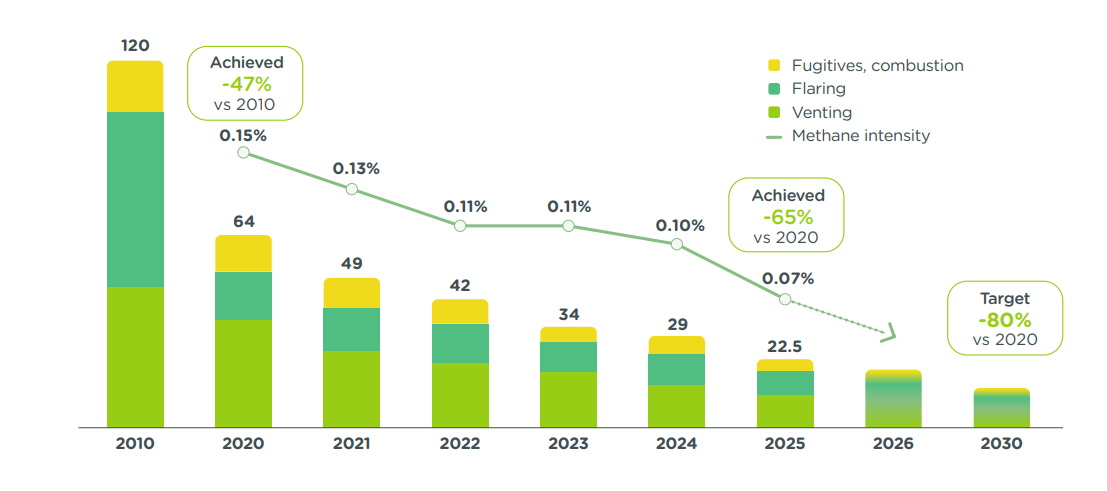
After achieving a 65% reduction in methane emissions from its operated assets in 2025 compared to 2020—thus exceeding its 60% reduction target—TotalEnergies is now aiming for a 70% reduction in emissions by 2026 and is on track to meet its 2030 target—or sooner—of an 80% reduction. In terms of methane intensity from operated oil and gas production, TotalEnergies reached 0.07% in 2025, thereby already achieving its 2030 target of falling below the 0.1% threshold.
Methane Emissions Operated (kt CH4)

From periodic monitoring
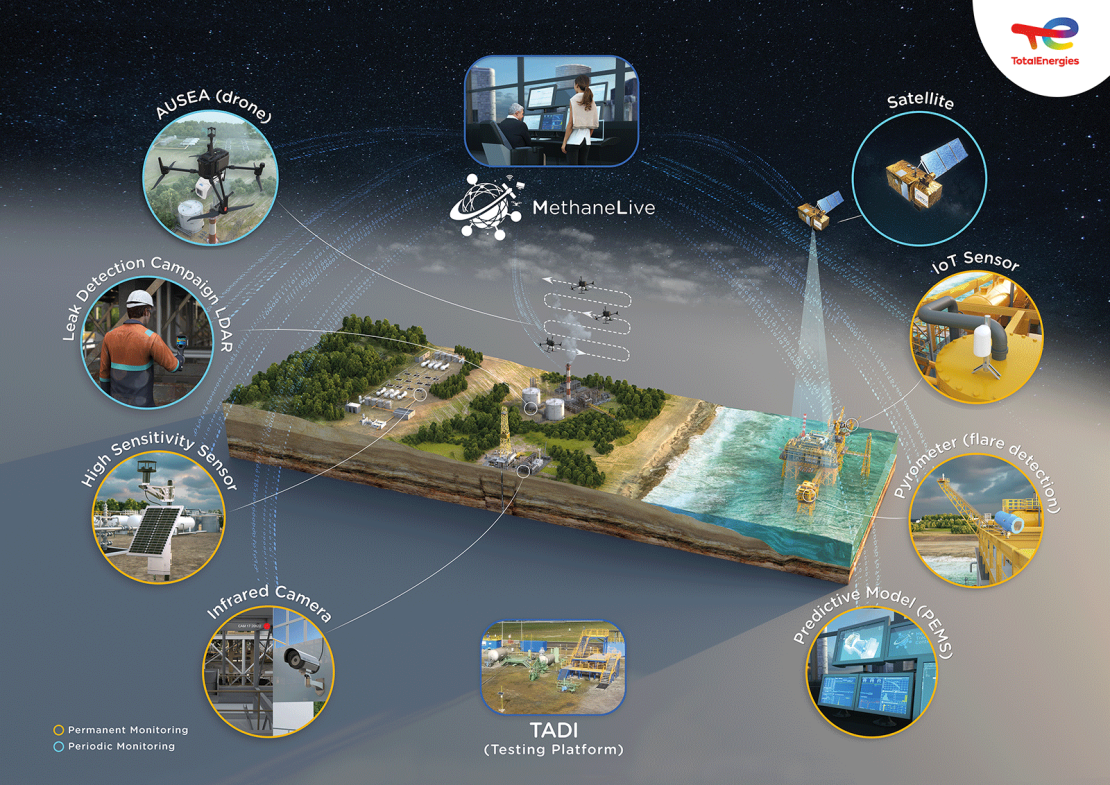
Leaks are monitored through annual leak detection and repair campaigns conducted at all of our upstream sites using a variety of technologies.
Leak Detection And Campaign Repair
LDAR (Leak Detection and Repair) is a practice that enables the detection, identification, and repair of fugitive gas leaks through periodic field measurements. All of Compangie’s upstream sites conduct annual LDAR campaigns.
Detection using AUSEA drones
All of the Company’s upstream sites are also surveyed at least once a year using AUSEA (Airborne Ultralight Spectrometer for Environmental Applications) drone technology.
Mounted on a drone, the ultra-lightweight dual sensor simultaneously detects methane and CO2 with high accuracy and is now considered an international benchmark technology and one of the best drone technologies(1) for methane detection . After interpretation, it provides a quantification of emissions in the form of mass flow rate (kg/h). TotalEnergies has shared this technology with several industry partners (including Petrobras, Socar, Sonangol, NNPC, ONGC, Oil India), and more recently in 2025 with Veolia in the waste and wastewater treatment sector.
Use of satellite images
Satellites equipped with multispectral and hyperspectral or methane-specific sensors detect potential methane plumes across all TotalEnergies assets—primarily those not operated by the Company—from space using short-wave infrared (SWIR) spectroscopy. They provide extensive land and maritime coverage, subject to favorable atmospheric conditions. TotalEnergies teams analyze publicly available satellite data, through private partnerships, or through collaboration with the International Methane Emissions Observatory (IMEO) of the United Nations Environment Programme (UNEP) via its global satellite-based methane leak monitoring program: MARS (Methane Alert and Response System).

To continuous, real-time monitoring
In 2025, as announced at COP29, TotalEnergies took a new step forward in identifying methane emissions in real time, whether related to leaks or sub-optimal operational processes, and in immediately implementing corrective measures.
This continuous detection plan relies on 13,000 sensors deployed across all operated Upstream assets and uses proven technologies such as IoT sensors, infrared cameras, flow meters, and predictive emission monitoring systems placed at combustion sources.
IoT Deployment
IoT sensors are advanced, wireless, battery-powered gas detectors used for continuous methane monitoring. They enable immediate detection of leaks or abnormal emissions and prompt response.
Pyrometers and optical lasers sensors
Pyrometers—optical laser sensors that measure temperature from a distance—are used for continuous monitoring of flare stacks. They enable constant verification that the flame remains lit and that methane is burning properly. Real-time detection is integrated directly into the flare stacks’ PEMS (Predictive Emissions Monitoring Systems).
Infrared cameras, or OGI (Optical Gas Imaging) cameras, can visualize leaks of methane and other hydrocarbon gases by detecting their infrared absorption signatures. They are available in fixed versions, for continuous monitoring, or portable versions, for spot inspections. These sensors offer extensive coverage, making them particularly well-suited for onshore facilities, and the fixed models provide continuous monitoring of processing and storage areas.
Predictive emission monitoring system
The PEMS (Predictive Emission Monitoring System) is a tool that continuously estimates emissions of pollutants, including methane, based on plant operating data and models, without the use of continuous gas analyzers.
Based on measurements taken at the stacks of each site, PEMS provides a reliable, real-time estimate of emissions from combustion equipment. It allows for daily monitoring of these emissions.
PEMS thus complements methane detection systems by specifically covering emissions related to combustion.
A comprehensive digital approach: the MethaneLive
In 2025, a MethaneLive was set up in Pau to centralize and consolidate data from various detection means worldwide, whether periodic or continuous and in real time. Using digital tools and the expertise of a team of around ten experts, the MethaLive analyzes data, alerts operators, and provides support when needed.
STORM: an innovative digital solution
STORM (Safety Tool for Operators and Remote Monitoring) is a digital solution developed to improve the detection and continuous monitoring of methane emissions at sites operated by on-site operators and the MethaneLive in Pau. By aggregating real-time data from multiple sources—IoT sensors, infrared cameras, acoustic sensors, weather data, and AUSEA drone or satellite imagery—STORM provides 2D/3D visualization that enables early identification of leaks, pinpointing their source, and accelerating corrective actions. Designed to facilitate the interpretation of multiple data sets while enhancing environmental performance.
After being tested at our Lacq site, STORM is currently undergoing a pilot program at the Tempa Rossa hydrocarbon production facility in Italy.

TADI, the technology testing and qualification platform
The TADI (TotalEnergies Anomalies Detection Initiatives) platform, established in 2015, is a 2,000-square-meter facility located at the Lacq Pilot Platform near Pau, equipped to replicate various leak scenarios in a controlled and risk-free manner.
TADI bridges the gap between laboratory testing and field operations by replicating realistic conditions to test and validate innovative gas detection and quantification technologies prior to their large-scale deployment.
The technologies used at TotalEnergies’ operating sites have thus been tested and validated at TADI, which is one of only two testing platforms in the world, alongside METEC (Methane Emissions Technologies Evaluation Center) at Colorado State University in the United States.
In April 2025, TADI and METEC(2) co-published an international protocol for evaluating methane detection and quantification technologies, demonstrating the Company’s commitment to fostering international collaboration for the harmonized evaluation of methane emission measurement and detection technologies.